































Events Calendar

Mon
Tue
Wed
Thu
Fri
Sat
Sun
M
T
W
T
F
S
S
30
12:00 AM - Hepatology 2021
31
1
2
3
4
7
8
9
10
11
13
14
15
16
18
19
20
21
22
23
24
25
27
28
29
30
1
2
World Nanotechnology Congress 2021
2021-03-29    
All Day
Nano Technology Congress 2021 provides you with a unique opportunity to meet up with peers from both academic circle and industries level belonging to Recent [...]
Nanomedicine and Nanomaterials 2021
2021-03-29    
All Day
NanoMed 2021 conference provides the best platform of networking and connectivity with scientist, YRF (Young Research Forum) & delegates who are active in the field [...]
Smart Materials and Nanotechnology
2021-03-29 - 2021-03-30    
All Day
Smart Material 2021 clears a stage to globalize the examination by introducing an exchange amongst ventures and scholarly associations and information exchange from research to [...]
Hepatology 2021
2021-03-30 - 2021-03-31    
All Day
Hepatology 2021 provides a great platform by gathering eminent professors, Researchers, Students and delegates to exchange new ideas. The conference will cover a wide range [...]
Annual Congress on  Dental Medicine and Orthodontics
2021-04-05 - 2021-04-06    
All Day
Dentistry Medicine 2021 is a perfect opportunity intended for International well-being Dental and Oral experts too. The conference welcomes members from every driving university, clinical [...]
World Climate Congress & Expo 2021
2021-04-06 - 2021-04-07    
All Day
Climatology is the study of the atmosphere and weather patterns over time. This field of science focuses on recording and analyzing weather patterns throughout the [...]
European Food Chemistry and Drug Safety Congress
2021-04-12 - 2021-04-13    
All Day
We invite you to meet us at the Food Chemistry Congress 2021, where we will ensure that you’ll have a worthwhile experience with scholars of [...]
Proteomics, Genomics & Bioinformatics
2021-04-12 - 2021-04-13    
All Day
Proteomics 2021 is one of the front platforms for disseminating latest research results and techniques in Proteomics Research, Mass spectrometry, Bioinformatics, Computational Biology, Biochemistry and [...]
Plant Science & Physiology
2021-04-17 - 2021-04-18    
All Day
The PLANT PHYSIOLOGY 2021 theme has broad interests, which address many aspects of Plant Biology, Plant Science, Plant Physiology, Plant Biotechnology, and Plant Pathology. Research [...]
Pollution Control & Sustainable 2021
2021-04-26 - 2021-04-27    
All Day
Pollution Control 2021 conference is organizing with the theme of “Accelerating Innovations for Environmental Sustainability” Conference Series llc LTD organizes environmental conferences series 1000+ Global [...]
Events on 2021-03-30
Hepatology 2021
30 Mar 21
Events on 2021-04-06
Events on 2021-04-17
Events on 2021-04-26
Articles

Cluster analysis, EHRs visualize, detect rare genetic

The study utilized a dataset comprising deidentified structured medical records from approximately 1.28 million patients across three healthcare institutions under the Singapore Health Services (SingHealth) cluster. This dataset covered a 3-year period from January 1, 2018, to March 1, 2022, and included the National Heart Centre Singapore, KK Women’s and Children’s Hospital, and Singapore General Hospital. The research adhered to relevant guidelines and regulations, receiving approval from the SingHealth Data Governance committee, with the SingHealth Centralised Institutional Review Board waiving the need for informed consent.

Data extraction involved collecting information from diverse sources within the SingHealth Database, such as laboratory results, radiology reports, pathology records, diagnoses, and detailed patient information. To mitigate privacy risks, only structured data was extracted initially, excluding free-text fields. Sensitive data fields were pseudonymized based on the “SingHealth Policy for Data Anonymisation” through a trusted third party. The pseudonymized data were then transferred to the Office of Insights and Analytics High-Performance Computer Lab, ensuring strict security measures to restrict access to authorized personnel only.

Post-deidentification, the structured data underwent normalization and standardization using the Population Builder tool, a third-party platform. Value sets in Population Builder facilitated grouping codes related to the same disease/phenotype, streamlining the filtering process. Two rare diseases, Fabry Disease and Familial Hypercholesterolemia (FH), were selected for the pilot project due to well-defined diagnostic criteria and extractable data from health records.

The diagnostic criteria for Fabry Disease and FH were outlined, and value sets were created to identify patients with known diagnoses. Data wrangling involved specific metrics examination for each patient cohort, retrieving relevant data using SQL queries, and subsequent manipulation in RStudio for analysis.

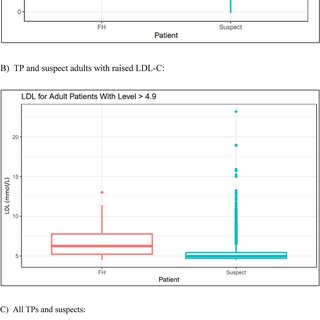
Data analysis encompassed visualization and statistical testing. The tidyverse and lubridate R packages were employed for visualizing demographic data through pie charts, scatterplots, boxplots, bar graphs, and a Venn diagram. Statistical testing involved a two-sample t-test to assess the difference in mean LDL-C levels between FH True Positives (TP) and suspects.

In summary, the study employed rigorous methods for data extraction, deidentification, and analysis, aiming to identify undiagnosed patients with rare genetic diseases through cluster analysis and visualization of electronic health records data.


