





























Events Calendar

Mon
Tue
Wed
Thu
Fri
Sat
Sun
M
T
W
T
F
S
S
26
27
28
29
30
31
1
2
3
4
6
7
8
10
11
12
13
14
15
17
18
20
21
22
24
25
28
29
30
31
1
2
3
4
5
Food and Beverages
2021-07-26 - 2021-07-27    
12:00 am
The conference highlights the theme “Global leading improvement in Food Technology & Beverages Production” aimed to provide an opportunity for the professionals to discuss the [...]
European Endocrinology and Diabetes Congress
2021-08-05 - 2021-08-06    
All Day
This conference is an extraordinary and leading event ardent to the science with practice of endocrinology research, which makes a perfect platform for global networking [...]
Big Data Analysis and Data Mining
2021-08-09 - 2021-08-10    
All Day
Data Mining, the extraction of hidden predictive information from large databases, is a powerful new technology with great potential to help companies focus on the [...]
Agriculture & Horticulture
2021-08-16 - 2021-08-17    
All Day
Agriculture Conference invites a common platform for Deans, Directors, Professors, Students, Research scholars and other participants including CEO, Consultant, Head of Management, Economist, Project Manager [...]
Wireless and Satellite Communication
2021-08-19 - 2021-08-20    
All Day
Conference Series llc Ltd. proudly invites contributors across the globe to its World Convention on 2nd International Conference on Wireless and Satellite Communication (Wireless Conference [...]
Frontiers in Alternative & Traditional Medicine
2021-08-23 - 2021-08-24    
All Day
World Health Organization announced that, “The influx of large numbers of people to mass gathering events may give rise to specific public health risks because [...]
Agroecology and Organic farming
2021-08-26 - 2021-08-27    
All Day
Current research on emerging technologies and strategies, integrated agriculture and sustainable agriculture, crop improvements, the most recent updates in plant and soil science, agriculture and [...]
Agriculture Sciences and Farming Technology
2021-08-26 - 2021-08-27    
All Day
Current research on emerging technologies and strategies, integrated agriculture and sustainable agriculture, crop improvements, the most recent updates in plant and soil science, agriculture and [...]
CIVIL ENGINEERING, ARCHITECTURE AND STRUCTURAL MATERIALS
2021-08-27 - 2021-08-28    
All Day
Engineering is applied to the profession in which information on the numerical/mathematical and natural sciences, picked up by study, understanding, and practice, are applied to [...]
Diabetes, Obesity and Its Complications
2021-09-02 - 2021-09-03    
All Day
Diabetes Congress 2021 aims to provide a platform to share knowledge, expertise along with unparalleled networking opportunities between a large number of medical and industrial [...]
Events on 2021-07-26
Food and Beverages
26 Jul 21
Events on 2021-08-05
Events on 2021-08-09
Events on 2021-08-16
Events on 2021-08-19
Events on 2021-08-23
Events on 2021-09-02
Articles

Cluster analysis, EHRs visualize, detect rare genetic

The study utilized a dataset comprising deidentified structured medical records from approximately 1.28 million patients across three healthcare institutions under the Singapore Health Services (SingHealth) cluster. This dataset covered a 3-year period from January 1, 2018, to March 1, 2022, and included the National Heart Centre Singapore, KK Women’s and Children’s Hospital, and Singapore General Hospital. The research adhered to relevant guidelines and regulations, receiving approval from the SingHealth Data Governance committee, with the SingHealth Centralised Institutional Review Board waiving the need for informed consent.

Data extraction involved collecting information from diverse sources within the SingHealth Database, such as laboratory results, radiology reports, pathology records, diagnoses, and detailed patient information. To mitigate privacy risks, only structured data was extracted initially, excluding free-text fields. Sensitive data fields were pseudonymized based on the “SingHealth Policy for Data Anonymisation” through a trusted third party. The pseudonymized data were then transferred to the Office of Insights and Analytics High-Performance Computer Lab, ensuring strict security measures to restrict access to authorized personnel only.

Post-deidentification, the structured data underwent normalization and standardization using the Population Builder tool, a third-party platform. Value sets in Population Builder facilitated grouping codes related to the same disease/phenotype, streamlining the filtering process. Two rare diseases, Fabry Disease and Familial Hypercholesterolemia (FH), were selected for the pilot project due to well-defined diagnostic criteria and extractable data from health records.

The diagnostic criteria for Fabry Disease and FH were outlined, and value sets were created to identify patients with known diagnoses. Data wrangling involved specific metrics examination for each patient cohort, retrieving relevant data using SQL queries, and subsequent manipulation in RStudio for analysis.

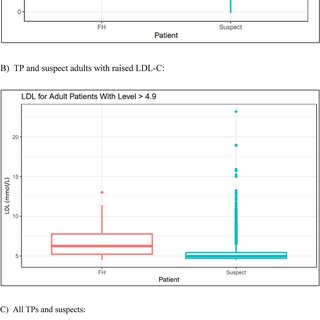
Data analysis encompassed visualization and statistical testing. The tidyverse and lubridate R packages were employed for visualizing demographic data through pie charts, scatterplots, boxplots, bar graphs, and a Venn diagram. Statistical testing involved a two-sample t-test to assess the difference in mean LDL-C levels between FH True Positives (TP) and suspects.

In summary, the study employed rigorous methods for data extraction, deidentification, and analysis, aiming to identify undiagnosed patients with rare genetic diseases through cluster analysis and visualization of electronic health records data.


