




































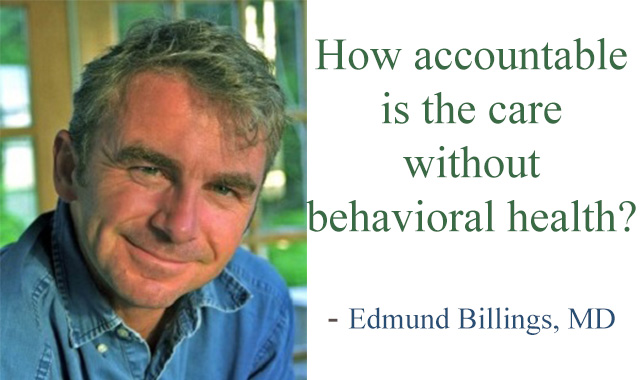
Edmund Billings, MD, is chief medical officer of Medsphere Systems Corporation, the solution provider for the OpenVista electronic health record.Continuity of care, accountability of care, unlikely without Medicare Shared Savings and Meaningful Use health IT incentives for mental and behavioral health providers
I could understand completely if many behavioral health providers and facilities feel like the proverbial red headed stepchild. All this energy and money poured into improving healthcare through comprehensive information technology (IT) systems and behavioral health is left holding an empty basket.
Even with regard to Accountable Care Organizations (ACOs), a concept that would seemingly require behavioral health incorporation, incentives are simply not there.
“… incentives for improving mental health care beyond screening across the wider range of type and severity of mental health conditions were not incorporated into the [Medicare Shared Savings Program (MSSP)] ACO final rule …” write a team of clinicians and public health experts in a March 2013 American Journal of Managed Care (AJMC) article entitled “Mental Health in ACOs: Missed Opportunities and Low Hanging Fruit.” “Lack of explicit regulations and incentives for mental health in the ACO rules represent a serious missed opportunity.”
The good news is that ACOs and mental and behavioral health professionals are finding ways to collaborate, integrate and improve patient care. They understand the revolving door created by health concerns that don’t receive sufficient attention.
“If you don’t address the underlying issues that drive their conditions, then you’re facing a situation where people will just be repeat users of the healthcare system, which runs up a lot of costs that hopefully could be avoided with appropriate care for the underlying conditions,” says Stuart Guterman, vice president for Medicare and cost control at the Commonwealth Fund.
At Crystal Run Healthcare ACO in New York City, the medical office building is home to primary care physicians, endocrinologists, infectious disease specialists and three psychiatrists. The entire group shares a waiting room and a connected EHR. Is this kind of setup an effective way to deal with Guterman’s concerns? It may be one way. Time will prove or disprove efficacy.
Smooth transition or abrupt halt?
As the ACO concept and underlying philosophy take hold, more mental and behavioral health organizations are embracing the idea of the “warm handoff” among providers, facilities and care teams.
“The idea is that you are accountable for patients’ care, whether they are coming into or going out of your system,” Virna Little, senior vice president of psychosocial services/community affairs at The Institute for Family Health, told Behavioral Healthcare magazine. “This accountability lasts until that patient gets to that alternate level of care and has a successful interaction.”
A warm handoff may require in-person interaction at the point of transition to or from a behavioral health facility / provider. It most certainly requires enough communication that all parties understand exactly who has primary responsibility for the patient, hence the Continuity of Care Document (CCD) required for Meaningful Use.
So, is the CCD only valuable as patients move in one direction from acute care to mental / behavioral care? Do patients not move both to and from behavioral health care? Might not CCDs be useful to all concerned, if we really are going to make providers accountable?
“This is a huge issue and one of the areas in which we fall down badly as a field,” says David Gastfriend, CEO of the Treatment Research Institute. “And it is probably responsible for a great deal of basic relapse.”
And this is where the incentives would come in. Accountable care makes tremendous sense, all agree, but the reality of expanding operations and taxing limited personnel resources even further is daunting for most behavioral health organizations. Logistical coordination in the form of Meaningful Use funds for necessary IT systems and Medicare Shared Savings incentives don’t appear to be coming in the short term, if ever.
“Until incentives and compensation are designed to foster this communication,” Gastfriend told Behavioral Healthcare, “this activity will depend on programs’ clinical integrity and dedication to excellence.”
Fair enough. We want our healthcare professionals to be motivated by integrity and excellence. Unless they work in acute care, in which case they can also be incentivized with money.
Using existing models
The team writing for AJMC makes clear that plenty of models exist, both financial and organizational, to enable effective mental and behavioral health integration with ACOs.
Organizationally, behavioral health may work into an ACO group in different ways depending on key factors:
- Whether practitioners work at the same practice site
- Whether mental health services are delivered by mental health professionals or primary care providers supported by mental health professionals
- The type of mental health professional (non-physician vs. physician)
The first model is working at the Washtenaw Community Health Organization primary care sites, where a mental health social worker is available full time and a psychiatrist is on site one half day per week. At the University of Michigan, the second model provides low-income patients with a team of social work care managers trained in mental and behavioral health. The VA uses model three by placing a full-time primary care physician in a mental health environment.
The necessary tools
The upfront costs and organizational challenges associated with integrating care, embracing warm handoffs and working within an ACO are prohibitive for most behavioral health organizations. The reality is that warm handoffs and full accountability must include clinical electronic data sharing in a standardized format, which is difficult for smaller facilities.
But degree of difficulty may not be an acceptable explanation moving forward. Behavioral health facilities will face insurance companies that are looking at the value of care, not just cost, and designing alternative payment models. If acquisition is a consideration, they will also have to grapple with interested private equity groups that want to see numbers ensuring successful transition from one step in a program to another before making a proposal.
There are more than a few ways to make incentives available; experts in healthcare generally and behavioral health specifically have provided several good alternatives. At some point in the near future Congress and CMS must decide to invest in behavioral health, too.
Click here to learn more about how Medsphere supports behavioral health care.


