



































Skepticism of innovative health technology is nothing new. But trends such as social technology will redefine healthcare’s future.
The history of healthcare is one of constant discovery, progress, and invention — and often skepticism from both practitioners and patients.
Take this prediction from The Times of London in 1834: “That it will ever come into general use, notwithstanding its value, is extremely doubtful because its beneficial application requires much time and gives a good bit of trouble.” The innovation in question: the newly invented stethoscope.
The same is true with the development of healthcare information technology (HIT) today. Its transformational power has yet to be fully recognized. While tools like electronic health records (EHR) are now accepted and mainstream, there are more wide-ranging, IT-driven opportunities still to be grasped. Above all, Internet access, mobile technologies, and social networks collectively offer a future where it is possible to deliver highly personalized care without necessarily having to do it in-person, or even with a doctor.
The IT crowd
There are three broad technology trends playing out, each of which will shift the future of healthcare. One is size. The sheer scale of digital technology is astonishing. In 2015 alone, the world will produce data equal to 120,000 times the total of all previously written words in history. This data will be generated by exponentially more powerful computing, and then stored in the cloud, to be accessible there from a growing range of devices. Europeans now have, on average, more than one cell phone per person. Locals in Dubai tote nearly two.
The second is a shift towards personalization. All consumer trends point towards greater customization for individual needs. Websites like Amazon track your shopping habits and recommend goods accordingly, while other online services only display content or updates relevant to your specific needs.
Third is that technology is more social than ever before. Networks such as Facebook, the most visited site in the US, have helped establish online communities of engaged users. Consumers increasingly create their own content and access what has been created by others. Social networks are not just a place to find friends. They are becoming platforms for content creation, idea sharing, and self-service. Some government agencies and technology companies have even deployed social software platforms for users to take over certain government functions and to provide each other first-level help desk functions. These networks, not only lower business costs, but also make users feel more engaged and in control, creating a feeling of ownership within the larger organization.
When it comes to healthcare, these developments can and will be applied in a huge variety of ways. Take for instance these three examples:
- Gaming is an established Internet activity with huge potential. Healthcare professionals, as seen through Wii Fit Plus, a popular exercise system developed by Nintendo, have begun to exploit people’s natural tendency to play games to improve cognitive skills and change behavior.
- Telehealth is another example offering patients remote access to healthcare professionals and has major advantages over traditional methods of delivery. It’s not just about meeting the needs of the underserved. It is a means of improving care for the already served. While still providing face-to-face care, telehealth gives each patient access to more than one doctor at a time and can further enhance a patient’s understanding of his or her own health, making the experience more personal.
- Health-specific social networks help practitioners deliver services and enable patients to play an active role in their care. By sharing and collaborating with others on similar health experiences and conditions, patients and practitioners build relationships, ask more questions and become, pioneers in the healthcare process.
One size doesn’t fit all
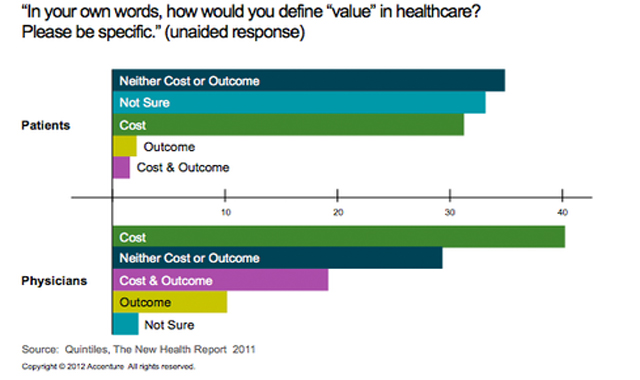
While developments in healthcare IT offer tremendous opportunities, it would be wrong to assume that all patients respond in the same way. In practice, the challenge is to embrace new technologies in the context of what patients actually want, rather than what practitioners want to use. Research suggests that practitioners value healthcare cost, where for patients cost is much less important (“The New Health Report,” Quintiles, 2011).
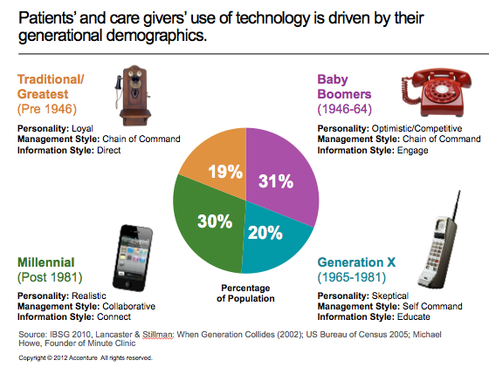
Demographics also play a crucial role. Older generations prefer more hierarchical structures in healthcare with information that is direct and specific. Younger generations have a tendency to be more collaborative and questioning. They like to take a greater role in sourcing information and advice. For example, when asked to name the most important factor in selecting a hospital, older generations most often say the recommendation of their doctors, while younger generations state that hospital reputation is much more significant (“Making the Market“, Thomson Reuters Healthcare, January 2009).
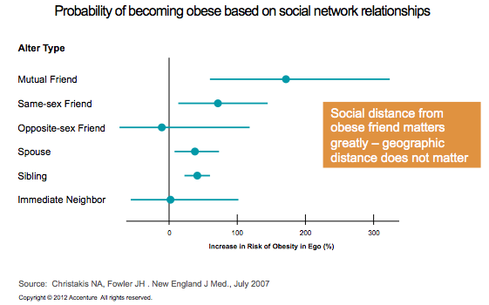
Inevitably, though, technology isn’t always a positive enabler. Some research suggests that social networks can promote negative health outcomes. A 2007 New England Journal of Medicine paper suggested that people who had social network relationships with friends suffering from obesity had, in certain cases, an increased possibility of becoming obese themselves (Christakis NA, Fowler JH, New England Journal of Medicine, July 2007).
While there are challenges to confront as healthcare professionals make better use of IT, the benefit can be extremely valuable. Personalized care at-a-distance could soon be as commonplace a healthcare tool as the stethoscope.
Kaveh Safavi, MD, JD, is the global managing director of Accenture’s health business
Though the online exchange of medical records is central to the government’s Meaningful Use program, the effort to make such transactions routine has just begun. Also in the Barriers to Health Information Exchange issue of InformationWeek Healthcare: why cloud startups favor Direct Protocol as a simpler alternative to centralized HIEs. (Free registration required.) Source


