
































Events Calendar

Mon
Tue
Wed
Thu
Fri
Sat
Sun
M
T
W
T
F
S
S
30
12:00 AM - Hepatology 2021
31
1
2
3
4
7
8
9
10
11
13
14
15
16
18
19
20
21
22
23
24
25
27
28
29
30
1
2
World Nanotechnology Congress 2021
2021-03-29    
All Day
Nano Technology Congress 2021 provides you with a unique opportunity to meet up with peers from both academic circle and industries level belonging to Recent [...]
Nanomedicine and Nanomaterials 2021
2021-03-29    
All Day
NanoMed 2021 conference provides the best platform of networking and connectivity with scientist, YRF (Young Research Forum) & delegates who are active in the field [...]
Smart Materials and Nanotechnology
2021-03-29 - 2021-03-30    
All Day
Smart Material 2021 clears a stage to globalize the examination by introducing an exchange amongst ventures and scholarly associations and information exchange from research to [...]
Hepatology 2021
2021-03-30 - 2021-03-31    
All Day
Hepatology 2021 provides a great platform by gathering eminent professors, Researchers, Students and delegates to exchange new ideas. The conference will cover a wide range [...]
Annual Congress on  Dental Medicine and Orthodontics
2021-04-05 - 2021-04-06    
All Day
Dentistry Medicine 2021 is a perfect opportunity intended for International well-being Dental and Oral experts too. The conference welcomes members from every driving university, clinical [...]
World Climate Congress & Expo 2021
2021-04-06 - 2021-04-07    
All Day
Climatology is the study of the atmosphere and weather patterns over time. This field of science focuses on recording and analyzing weather patterns throughout the [...]
European Food Chemistry and Drug Safety Congress
2021-04-12 - 2021-04-13    
All Day
We invite you to meet us at the Food Chemistry Congress 2021, where we will ensure that you’ll have a worthwhile experience with scholars of [...]
Proteomics, Genomics & Bioinformatics
2021-04-12 - 2021-04-13    
All Day
Proteomics 2021 is one of the front platforms for disseminating latest research results and techniques in Proteomics Research, Mass spectrometry, Bioinformatics, Computational Biology, Biochemistry and [...]
Plant Science & Physiology
2021-04-17 - 2021-04-18    
All Day
The PLANT PHYSIOLOGY 2021 theme has broad interests, which address many aspects of Plant Biology, Plant Science, Plant Physiology, Plant Biotechnology, and Plant Pathology. Research [...]
Pollution Control & Sustainable 2021
2021-04-26 - 2021-04-27    
All Day
Pollution Control 2021 conference is organizing with the theme of “Accelerating Innovations for Environmental Sustainability” Conference Series llc LTD organizes environmental conferences series 1000+ Global [...]
Events on 2021-03-30
Hepatology 2021
30 Mar 21
Events on 2021-04-06
Events on 2021-04-17
Events on 2021-04-26
Articles

Jul 10 : Even more EHRs need to go digital

ehrs

In recent years, policymakers have raised alarm bells that digitizing health records would lead to rampant fraud and abuse.

A 2009 law created incentives for hospitals to move from paper to electronic health records. The digital systems, critics warned, could make it easier for doctors and hospitals to “upcode”, billing insurers for more intensive — and more expensive — care than was actually provided.

 “Despite conventional wisdom that the wide adoption of health IT would decrease unnecessary tests and imaging as physicians had better electronic access to records, other early evidence actually suggests the opposite,” wrote six Republican senators in a 2013 report. “Health IT may have increased the likelihood that duplicative, unnecessary care, such as redundant testing or procedures, will be done.”

Turns out, those fears may be overblown: a new study published in Health Affairs, the adoption of EHRs was not associated with patients being billed as “sicker”, or with higher payments to Medicare.

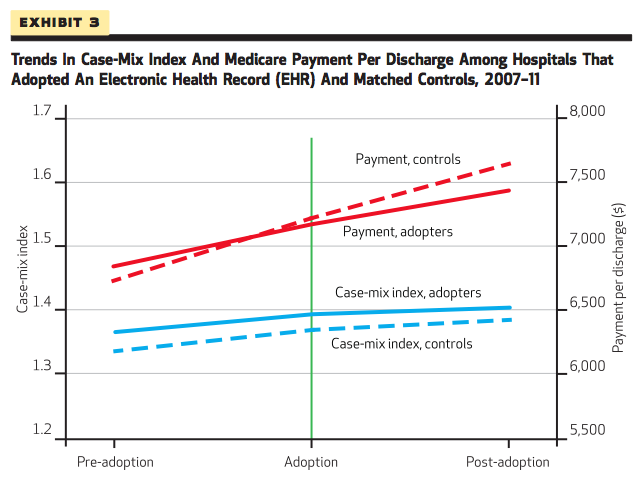
The chart below illustrates trends in “case-mix” (how sick a hospitals patients were reported to be) and Medicare payment per patient released from the hospital. If doctors were upcoding, you’d expect to see a sicker group of patients  among the hospitals implementing electronic records after they adopted EHRs.

Though the case-mix index and payment increased for all hospitals over time, the increases didn’t vary much based on whether or not the hospitals adopted electronic records.
Screen_shot_2014-07-09_at_11.59.25_am

Medicare payment actually went up more for the controls — hospitals that did not adopt EHR — than for hospitals that digitized their records. However, this difference (about $96 per patient discharged) was not statistically significant.

So far, concerns about up-coding have been largely driven by anecdotal reports, the authors say. The New York times also used Medicare data in 2012 to report that EHR adoption was associated with higher payment. However, their analysis did not rigorously control for differences across hospitals that could matter, like size and whether a hospital is an academic medical center.

The HHS Office of Inspector General recently recommended that the government undertake a large-scale policy effort to target at reduce fraudulent billing. This research suggests that the time and money required would be better spent elsewhere.

“A policy intervention to reduce fraud is therefore not likely to be a good use of resources,” the authors write. “Instead, policy makers should focus on ensuring that hospitals use EHRs in ways that are likely to reduce health care spending and improve the quality of care.”


Source
