


















































By Magaly Olivero, Conn. Health I-Team Writer
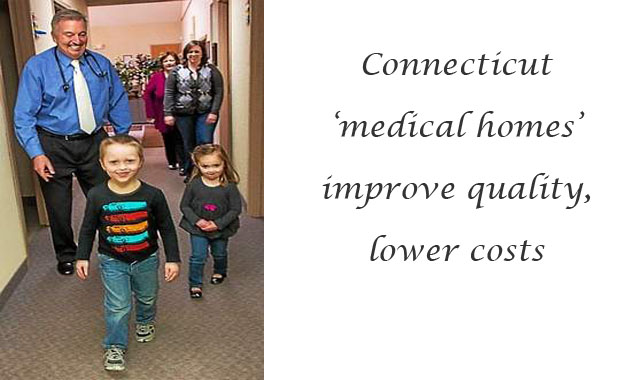
The use of nationally certified medical homes to coordinate care of Connecticut’s Medicaid patients has led to improved quality, a 2 percent cut in per-person costs, and a 32 percent increase in the number of participating providers during an 18-month period.
The news comes as the state moves forward with plans to jumpstart the medical home movement in Connecticut with an expanded “Glide Path” program that would assist all practices — not just those that accept Medicaid patients — working to become medical homes. The program, still under development, would require practices to meet national standards.
The state initiative has shed light on the challenges facing Connecticut’s medical homes, including the costs of implementing an electronic medical record and care coordination strategies. Experts say medical homes can improve quality, cut costs and reduce health inequities among all patients, not only those in the state’s Medicaid program.
Medical homes refer to a way of delivering primary care that helps people stay healthy by managing chronic conditions and keeping up with preventive care. In a medical home, a team of healthcare providers works closely with patients to coordinate every aspect of care. Providers use electronic tools to remind patients about screenings and track patient outcomes. Some insurers offer certified medical homes financial incentives for meeting quality and other criteria.
A total of 833 clinicians in 222 practices in Connecticut have been certified as patient-centered medical homes by the National Committee for Quality Assurance, the nation’s largest credentialing organization. A total of 131 Connecticut practices have purchased the NCQA survey tool in 2014 so far, twice as many as in all of 2013. “That’s a strong indication that many practices are getting ready to apply for recognition,” said Apoorva Stull, an NCQA spokeswoman.

Connecticut was the first in the nation to adopt the medical home model for Medicaid, the state’s health coverage program for the poor.
“Our experts note that the patient-centered medical home approach has had a demonstrable effect on health outcomes and member satisfaction,” said David Dearborn, spokesman for the state Department of Social Services, which administers Medicaid. The improvements in the Medicaid program took place between January 2012 and June 2013.
For example, the quality of care delivered to adult and pediatric Medicaid beneficiaries by certified “patient-centered medical homes” exceeded the quality of care provided by nonmedical home practices across a number of areas, according to state statistics.
Children seen in Medicaid medical home practices were over 10 percent more likely to receive recommended EPSDT (early and periodic screening, diagnostic and treatment) screenings. Medical homes also scored better with well-child visits, adolescent well-care visits, adult access to preventive health services, annual dental visits, eye and cholesterol screenings for people with diabetes, and managing asthma patients with a history of emergency department visits.
Medicaid patients also reported high satisfaction with their medical home care. They waited less time for appointments with primary care physicians, had greater access to specialists, and were more likely to come in for check-ups and routine care. Parents said pediatric providers listened carefully and were knowledgeable about their child’s medical history.
Health care providers benefitted, as well, receiving higher reimbursements for managing the care of their Medicaid patients. The state distributed $2.4 million in “enhanced payments” to 15 certified medical homes and one hospital outpatient primary care clinic. Seventeen physician practices working toward certification received $575,000 from the state.
Although most of Connecticut’s Medicaid medical homes are certified by NCQA, the value of seeking national accreditation came into question recently as the state considered new criteria for future medical homes. Critics say the national process is costly and administratively burdensome, and in some cases, certified practices haven’t changed at all. Health advocates say national standards ensure quality. In the end, the state’s Healthcare Innovation steering committee voted to use NCQA national standards as the patient-centered medical home standard for the proposed new Glide Path program.
Dr. Thomas Meehan, chief medical officer for Qualidigm, a health care consulting firm that helps practices become medical homes, believes the momentum has slowed in Connecticut. “Primary care physicians are interested in medical homes as a way to improve quality of care,” he said. “But from a business perspective, there has not been a financial return on the investment.”
One reason Connecticut doctors are slow to embrace medical homes is the cost of computer equipment and software to operate an integrated electronic medical record — or EMR, providers and state officials said. Connecticut ranks 49th in the nation when it comes to adopting electronic medical records, according to the U.S. Centers for Disease Control and Prevention.
“The electronic medical record is the cornerstone of having a patient-centered medical home. Without it, we can’t track care and improve care where it’s needed,” said Dr. Veena Channamsetty, chief medical officer of Community Health Center, Inc., which provides medical, dental and behavior health services at health centers, schools, shelters and mobile dental office.
Having an integrated electronic medical record allows providers to deliver high-quality and efficient care no matter where the patient receives services, she said. For example, a patient initially seen at a health center can seamlessly access follow-up care at a homeless shelter.
“Our providers know exactly where things stand with the care plan by looking at the electronic medical record. There’s no duplication of services or tests,” said Channamsetty. “That’s the great thing about the electronic medical record when it’s used correctly.”
Dr. David Howlett, who operates a medical home in north central Connecticut at East Granby Family Practice, understands why some providers are reluctant. His patients have benefited from efforts to coordinate and track care using electronic tools with more people receiving preventive care and fewer needing emergency department visits or hospital admissions.
But transforming the practice into a medical home has been costly, including $600,000 for health information technology and hundreds of hours in staff time to comply with national certification requirements, he said.
“We take pride in the high-quality care that our patients receive. But that doesn’t help pay for raises,” said Howlett, a board member at the Connecticut Academy of Family Practices. “It’s becoming somewhat of a disincentive to enter family practice just at the time that we want students to feel they’re doing something great by going into primary care.”
Care coordination remains one of the most “problematic” areas for pediatric medical homes trying to connect children and families to mental health and other services, said Lisa Honigfeld, vice president for health initiatives at the Child Health and Development Institute of Connecticut.
“You can’t be a medical home by yourself. You have to be part of a medical neighborhood,” she said. “We think of each practice in isolation and lose sight that the ideal implementation of medical homes needs to happen in a system that supports practices in a variety of ways.”
For instance, providers who need help coordinating care can call the Child Development Infoline to learn about programs and services. Other efforts include plans by the state Department of Public Health to establish statewide “care coordination collaboratives” and plans for a statewide system allowing pediatric providers to consult with child psychiatrists by telephone.
“We need to let practices know that they aren’t alone,” she said.
This story was reported under a partnership with the Connecticut Health I-Team (www.c-hit.org).


