




































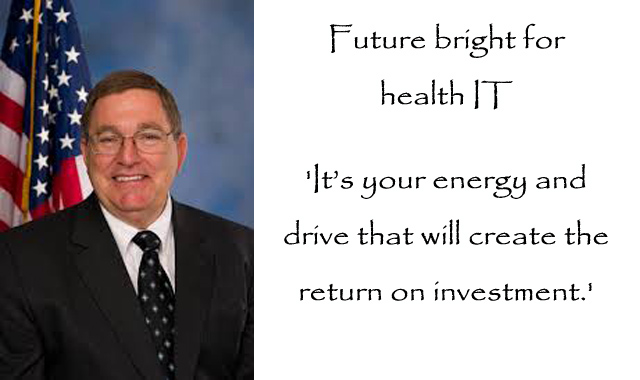
U.S. House Representative Michael Burgess, MD, R-Texas, vice-chair of the subcommittee on health within the House Energy and Commerce Committee, is an obstetrician and has not always been convinced of the benefits of health IT. But, Hurricane Katrina, changed his mind. And, today, Burgess is a champion.
As he told attendees at the keynote he delivered June 18 at the Government Health IT Conference in Washington, D.C., the cost of IT infrastructure in the 1980s in the large multi-specialty practice in which he practiced was prohibitive.
“It has not always been a happy alliance between the physician and the information architecture,” he said. “The transition of health IT for physicians has been clunky.”
With the advent of the year 2000, Burgess was encouraged to purchase yet another computer system, which turned out to be unnecessary when Y2K did not wreak havoc that was expected. Yet another disappointing and costly experience in health IT, he admits.

Katrina turns the tide of health IT opinion
What turned the tables for Burgess was Hurricane Katrina. He saw first-hand the loss of vital patient information in water-logged hospitals, which later developed black mold and required biohazard gear to look at. Doctors did the best they could to fill in patient medical history with a patient’s verbal memory of their medication.
“Katrina provided a first-hand look at why EHRs are important,” Burgess said.
Now, his endorsement is strong. “If you want to save money in healthcare, it requires an electronic platform, for early detection and proper screening,” he said.
In addition, in states like his home state of Texas, telemedicine is imperative, with so few doctors per square mile. “There’s no question that the advances in telemedicine are opening up the ability to give quality care,” Burgess said.
Burgess notes how far things have come from when in the 1980s doctors would never hope to receive reimbursement for a telephone conversation with patients.
The `pause’ in meaningful use
Burgess said the opinion on the Meaningful Use EHR Incentive Program depends on “which side of the fence on which you sit.”
Farzad Mostashari, former national coordinator for health information technology told Burgess last year, “whatever you do, don’t delay meaningful use.”
Unfortunately, that’s not what happened. Stage 2 has been delayed. Burgess prefers to call it “only a pause.” And, he advises stakeholders to take advantage of the pause to “make sure the program is working from a standpoint of being helpful.”
Patient safety should be a driving force, he said. “Here’s the bottom line: Patients need to trust this stuff in order for it to work.”
Healthcare consumers are constantly bombarded with news stories that are casting doubt on the security of their personal information, be it health, financial or otherwise. Public trust in health IT is “absolutely critical,” he said. “The federal government has a role to play here.”
The future is bright
Some older physicians have asked Burgess if meaningful use is merely an effort to get them to retire. Burgess has said he sympathizes. But the future ahead is brighter than ever for physicians, especially those who have always only known technology.
“The ability for tomorrow’s doctors to eliminate suffering is going to be nothing ever known before,” he said.
Patients are demanding healthcare apps for their phones, and the number of apps is growing exponentially. “No generation of doctors has ever had these tools,” he said.
“The consumer side is going to drive this,” Burgess said of progress. “This is the generation that would rather have a smart phone than a car. This segment of the population will literally demand the change. This generation will be changing healthcare.”
There is still a lot to be accomplished, he admits. Burgess said his disappointment in the Veterans Administration and Department of Defense in building interoperability thus far does not provide a good example for the private sector.
But, as legislators and regulators move forward in all health IT endeavors, Burgess advises, “let’s minimize what’s punitive and accentuate what’s positive.”
“It’s your energy and drive that will create the return on investment,” he told attendees of the conference.


