



















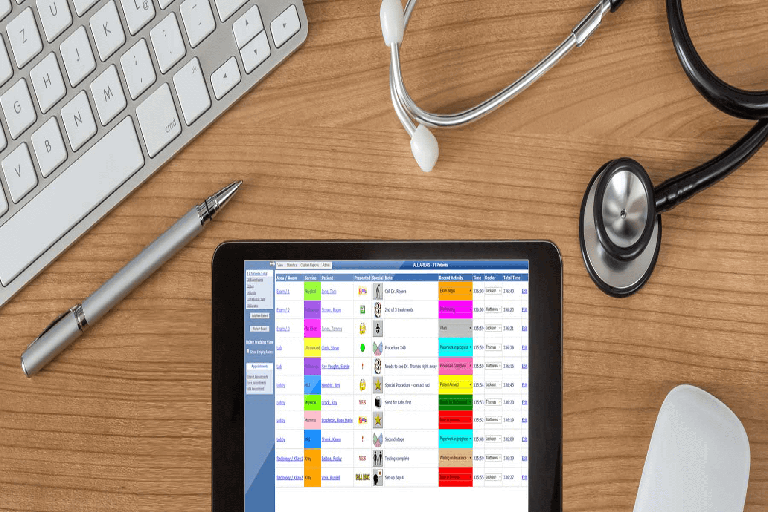









Despite the growth of computer technology in medicine, most medical encounters are still documented on paper medical records. The electronic medical record has numerous documented benefits, yet its use is still sparse. This article describes the state of electronic medical records, their advantage over existing paper records, the problems impeding their implementation, and concerns over their security and confidentiality. As noted in the introduction to this issue, the provision of medical care is an information-intensive activity. Yet in an era when most commercial transactions are automated for reasons of efficiency and accuracy, it is somewhat ironic that most recording of medical events is still done on paper. Despite a wealth of evidence that the electronic medical record (EMR) can save time and cost as well as lead to improved clinical outcomes and data security, most patient-related information is still recorded manually. This article describes efforts to computerize the medical record.
Purpose of the Medical Record
The major goal of the medical record is to serve as a repository of the clinician’s observations and analysis of the patient. Any clinician’s recorded interactions with a patient usually begin with the history and physical examination. The history typically contains the patient’s chief complaint (i.e., chest pain, skin rash), history of the present illness (other pertinent symptoms related to the chief complaint), past medical history, social history, family history, and review of systems (other symptoms unrelated to the present illness). The physical examination contains an inventory
of physical findings, such as abdominal tenderness or an enlarged lymph node. The history and physical are usually followed by an assessment which usually adheres to the problem-oriented approach advocated by Weed (1969), with each problem analyzed and given a plan for diagnosis and/or treatment.


