





























What Muscles Do Planks Work? How to Do a Proper Plank
Whether you’re taking a group fitness class or following an exercise DVD at home, it’s a sure bet that you’ll be doing planks at some point during the workout—and for good reason. Planks are the ultimate test of total-body strength, not just your core. That’s why they’re the groundwork for many bodyweight exercises, like push-ups and burpees.
“The plank is one of those jack-of-all-trades exercises you can carry in your back pocket to strengthen not only your core, but also your chest, arms, back, legs, and booty,” explains, Nicole Blades, as NASM-certified trainer at BodyRoc FitLab in Connecticut. “A plank with proper form can help improve your posture, too. The best part is, this dynamic move doesn’t require any equipment. It’s a total bodyweight exercise.”
So what muscles do planks work, exactly?
Whether you’re in a low or high plank, you’re balancing weight on your arms and toes. This targets a wide range of muscles, especially the rectus and transverse abdominis, Blades says. The rectus abdominis are the front muscles in the abdomen that support the muscles of the spine and help keep organs in the abdomen area in place. They’re known as the “six-pack muscles” because they give your abs shape and definition.
On the other hand, the transverse abdominis (TVA) muscles are known as the “corseting muscles” because they cinch the waist and act as core stabilizers that support the low back. In fact, a weak TVA is often the culprit of lower back pain.
“Planks also target the trapezius and rhomboid muscles (upper back muscles) in your back, as well as the pectorals (chest) and serratus anterior (the serrated-shaped muscles that wrap around the side of your chest and shoulder),” Blades says.
When you engage your upper body muscles, you’re putting less pressure on your core and are able to hold a plank longer. You can further engage your shoulders and back muscles in a plank when you grip the floor more with your fingers and hands. Keeping a neutral spine will also help relieve pressure on your neck and make holding a plank less uncomfortable.
But core includes your hips and low back, too.
When people think of their core, they tend to think only about their abs—but the powerhouse includes your hips and low back, too. “A solid plank works the quads (front of the thighs), glutes, and calf muscles in your lower half,” Blades says.
In fact, your hips play a big role in making your planks stronger. Your hips are connected to your lower abs (aka the lower part of your rectus abdominis), so engaging these muscles will help you hold the position longer with proper form. When you squeeze your hips, you’re also able to brace your core more and keep your low back lifted—something that many fitness newbies tend to overlook.
How to do a proper plank
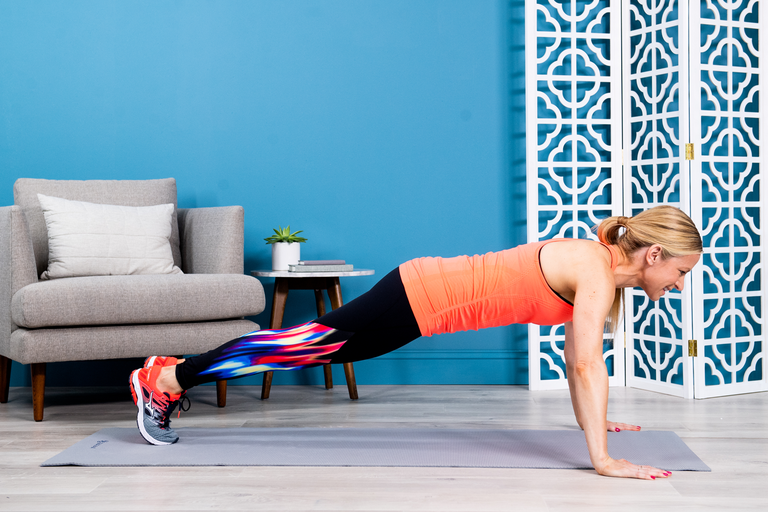
- There are many different ways to achieve the perfect plank, but here’s a step-by-step breakdown on how to do a high plank.
- Get into a tabletop position with your shoulders directly over your wrists and hips in line with your knees.
- Engaging your abs, shoulders, back, and glutes, extend your legs back to straighten into a plank and hold
- If you can, do the exercise in front of a mirror, to check that your butt isn’t raised. (A common mistake, but your body should be flat as opposed to an upside down-V shape.)
For a modified plank, Blades suggests dropping to your knees instead of holding yourself up on your toes. “Get on all fours and walk your hands forward so your body forms a slanted line from your head to knees, like you would in a modified push-up,” she says. To recruit the glutes and hamstrings, keep your feet lifted toward your butt. Once you master this variation, you can work your way up to a forearm plank by placing your forearms on the ground.
How long should you hold a plank?
Aim to hold a plank for 15 seconds, then work your way up to 30, 45, 60 seconds, and so on. Instead of watching the clock, Blades suggests setting a timer. This way you’re not painstakingly watching the seconds go by. Don’t forget to also use your breath, deeply inhaling and exhaling. By focusing on your breath, you’ll be able to help set your mind at ease throughout the uncomfortableness.
The best way to hold a plank longer? “Practice, practice, practice,” Blades says. “The more you do the exercise, the more strength and endurance you will build and the longer you will be able to hold it. If you feel like you’re about to quit, push yourself to stay in plank a few seconds more. You can do it!”


