










How modernised communication architecture helps UK hospital streamline care
Since the Royal National Orthopaedic Hospital (RNOH) invested in an advanced communication ecosystem, improved cooperation between healthcare workers has triggered many related benefits, from flexible workflows to a better patient experience.
For RNOH, the largest specialist orthopaedic hospital in the UK, a few years ago it became clear that pagers no longer met the requirements and growing expectations of healthcare professionals and patients. A robust communication strategy, the core of sustainable and outstanding patient care, required a modern approach and a coherent infrastructure.
It wasn’t just the RNOH that had to face this challenge because, in 2019, Matt Hancock, Health and Social Care Secretary demanded that NHS trusts phase out using archaic pagers for communications. It’s been 70 years since the first pagers were used, but today’s complex healthcare challenges require more relevant tools that are secure, quicker and more effective.
The RNOH opted to leverage Vocera technology. Within a short time, it accelerated the building of collaborative synergy between healthcare professionals, minimizing the strain and creating an agile workflow structure. During the COVID-19 crisis, the new communication standards helped the medical facility reorganise and prepare to treat patients with coronavirus.
The average time to mobilise the care team dropped down by 84%
“We needed a technology that could empower our ward staff to communicate easily with each other and the patients,” says Dr Saroj Patel, Chief Digital and Innovation Officer at RNOH. One of the requirements was that the system, right from day one, should be integrated with the patient call bell and telephone system. A radical shift in such a critical organisational domain was challenging but also necessary.
“As soon as people saw the potential of the technology, they also recognised a lot of other uses for it. They even demanded access to it.” Dr Patel highlights that having the right digital innovation as part of a combined transformation strategy helps deliver huge benefits very quickly. Finally, the RNOH rolled-out Vocera across all clinical areas and now it is used by the entire staff, including doctors, nurses, therapists, pharmacists, porters and senior managers. Task coordination has been remodelled, resulting in an 84% reduction in care team response time. The new communication standards led to a better patient experience and improved quality of care.
Give people the right digital tool to support problem-solving
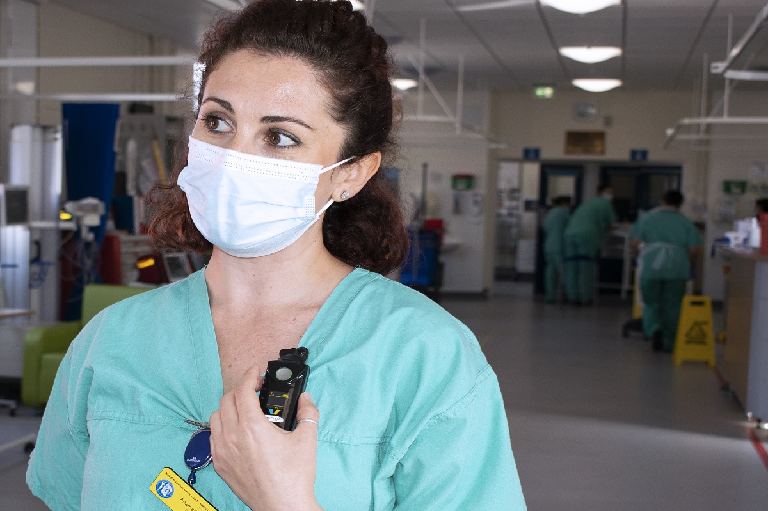
Vocera technology consists of hands-free operable badges and a smartphone app which runs on the clinicians’ smartphones. Hospital staff can be called by name role or group, so that everybody can reach the right person and group without having to remember the name or number of each team member. This reduces noise and distraction, contributing to building a staff-friendly working environment, speeding up information-sharing, preventing clinical cognitive overload and improving safety.
“We have created a team that we could never have established without Vocera. The technology forced us to look at how we were setting up our Crash team and emergency services. It changed the way we think about workflow. Finally, Vocera became a norm for clinical communication, whether for an emergency on-call scenario or just routine discussions amongst staff,” says Bela Haria, Digital Services Senior Project Manager at RNOH. The current communication architecture is coherent and transparent. Management and analytical tools enable the administrative staff to form new or rearrange existing teams, follow who is on call, logged in or available, and which roles the healthcare professionals have. And all this has become available in a hospital with buildings scattered over a 100-acre site. “If you give people the right tool to communicate, they know how to troubleshoot,” adds Haria.
During the COVID-19 pandemic, the system helped continue seamless care
For RNOH, patient-centered care is at the heart of all processes. Since implementing the technology, every patient can be directly connected with a nurse just at the touch of a call button. It reduces response time significantly, improves staff efficiency and increases patient safety. By getting rid of unnecessary phone ringtones and pager sounds, the hospital decreased internal noise levels, creating a patient-friendly ambience at the same time.
In response to the COVID-19 pandemic, the RNOH expanded the ICU facilities by 300%. Matt Phillips, Lead Clinical Practitioner for the Acute Intervention Team at RNOH, remembers how within ten days, the elective surgery hospital unit was transformed into an acute care facility. “The Vocera Platform allowed us to quickly customise workflows, making communication safer even for those wearing PPE and minimising infection risk. It would not have been possible on such a scale with the old telephone systems,” he emphasises. But the list of benefits is much longer: reduced walking time, integration with the patient call bell system, analytics that enable adoption success measurement and troubleshooting.
Matt Phillips mentions one more advantage – the gift of time. Before Vocera technology was introduced, the time to mobilise the Crash team averaged two minutes and five seconds. “After the deployment of Vocera, it dropped to just 20 seconds. Well-orchestrated communication also means better patient outcomes and experience,” concluded Phillips.
Source : Emea